


What sports car detailing truly means for your vehicle

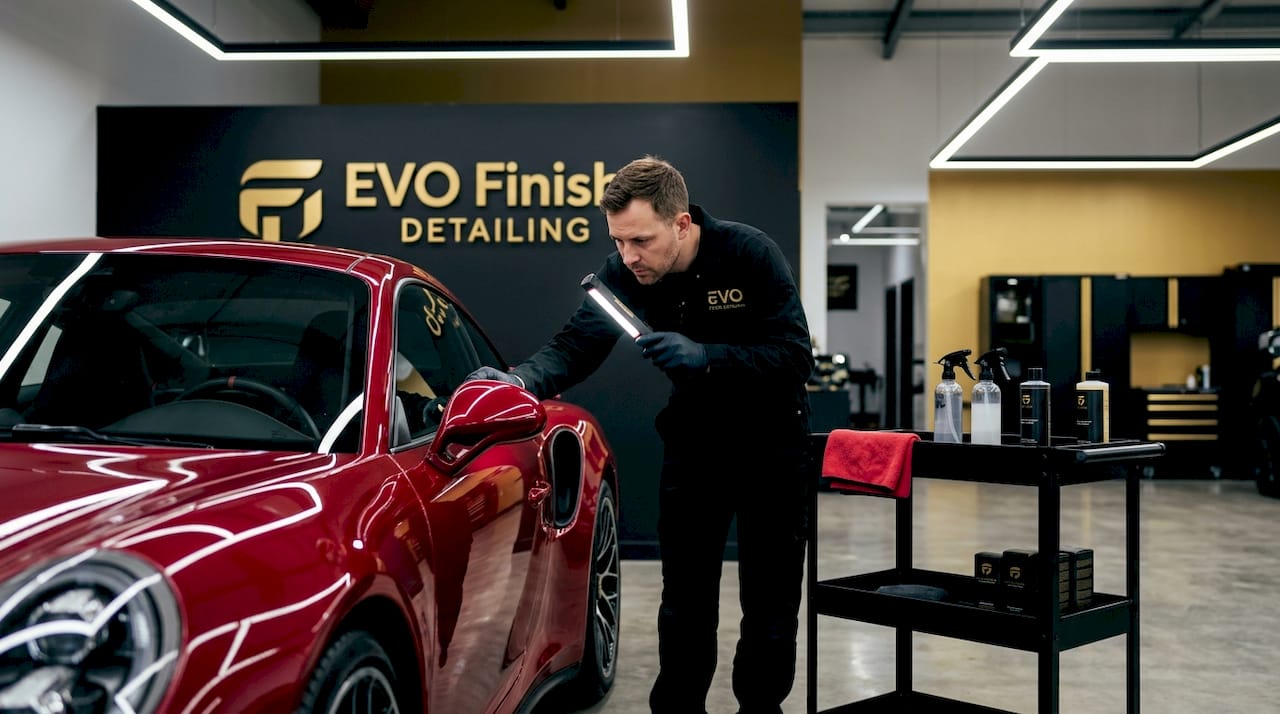
Professional detailing is not a glorified car wash. For sports car owners, it is a structured, multi-stage process that addresses every surface, from clear coat depth to brake caliper finish, with precision tools and specialized products tailored to high-performance materials. As car detailing experts confirm, detailing is a technical discipline with measurable benefits for aesthetics, longevity, and resale value. This guide covers every stage of the process, explains what separates professional results from amateur attempts, and shows you exactly what your sports car deserves.
Table of Contents
Key Takeaways
Point | Details |
Detailing is technical | Professional sports car detailing involves structured, multi-step processes not found in a regular car wash. |
Proper workflow matters | Steps are ordered for safety and effectiveness, covering exterior, wheels, and interior. |
Wheels require attention | Wheel and brake care are vital for both looks and long-term performance, needing specialized techniques. |
Paint correction isn’t universal | Not every sports car needs or benefits from paint correction—expert assessment is key. |
Interior care protects value | Gentle, specialized interior detailing keeps materials, electronics, and resale value in top shape. |
What makes sports car detailing different?
Most standard vehicles get a wash, maybe a wax, and they look fine. Sports cars are a different situation entirely. Their materials are more varied, their finishes more sensitive, and the cost of getting it wrong is significantly higher.
As detailing professionals explain, detailing is a multi-step process for cleaning, refining, and protecting surfaces, not just a more thorough wash. The distinction matters enormously when your car features a $15,000 bespoke paint finish, hand-stitched Alcantara seats, or exposed dry carbon fiber panels. These materials react differently to chemicals, abrasives, and even sunlight. A generic car care routine that works on a daily driver can leave swirl marks, chemical stains, or permanent hazing on a sports car’s finish.
Here is what makes sports car detailing uniquely demanding:
Exotic paint finishes: Matte, satin, tri-coat, and color-shift paints require specific, pH-neutral products that won’t disturb the finish chemistry.
Carbon fiber components: Exposed carbon fiber needs UV protection and non-abrasive care to prevent oxidation and surface crazing.
Low ground clearance: Sports cars sit close to the road, meaning more road spray, more brake dust contamination, and harder-to-reach areas.
Wider, larger wheels: High-performance wheels collect more brake dust and road grime, requiring dedicated tools to clean properly.
Delicate clear coats: Some manufacturers apply thinner clear coats for weight savings, leaving less margin for correction.
The difference between understanding the detailing vs. car wash distinction is not just academic. It is financial. Improper polishing can burn through a thin clear coat in one session, requiring a full respray that costs thousands of dollars.
“Detailing done wrong is not a minor inconvenience. On a sports car, one careless session can permanently alter the finish and drop the vehicle’s value in a meaningful way.”
Pro Tip: Never use the same wash mitt, sponge, or brush on your sports car that you or anyone else has used on a standard vehicle. Cross-contamination from embedded grit causes fine scratches that accumulate over time and eventually dull even the sharpest paint.
The essential steps: A pro’s workflow
Knowing what makes detailing unique, here is how professionals tackle the job from start to finish. A disciplined sequence protects surfaces, prevents contamination, and ensures each step builds effectively on the last.
According to Chemical Guys’ detailing methodology, a proper professional workflow includes pre-wash, hand wash, wheel and tire cleaning, decontamination, optional paint correction, protection, and a final inspection. Skipping or rearranging steps is not a shortcut. It is a way to introduce contamination, cause scratching, or apply protection to a surface that has not been properly prepared.
Here is the professional sequence we follow:
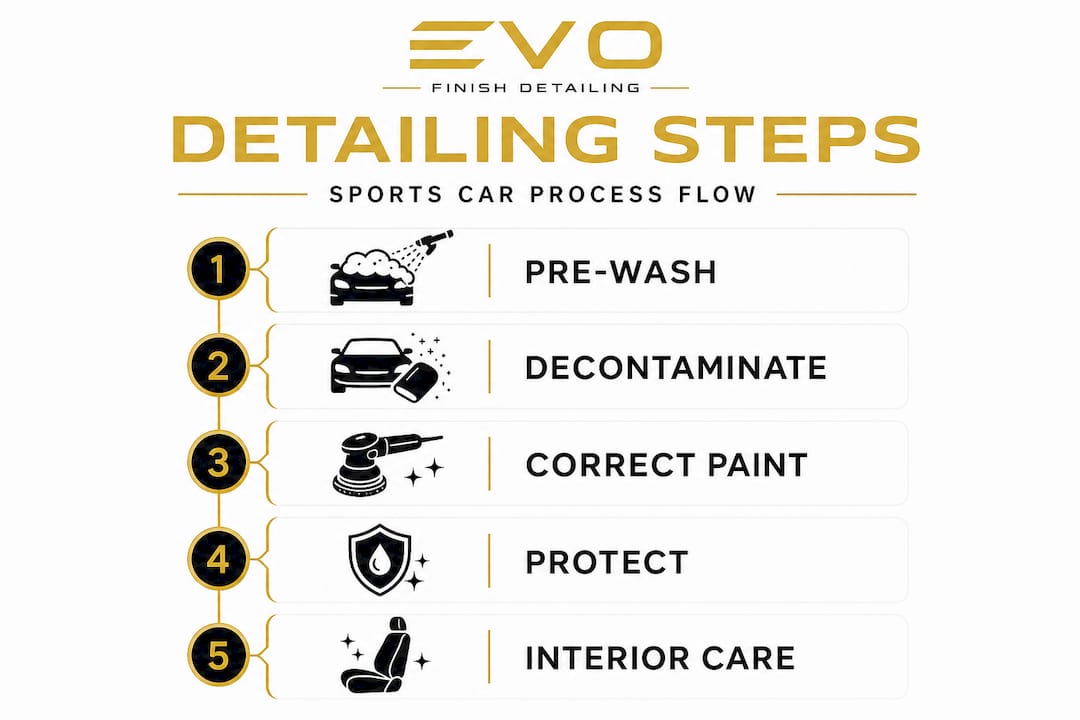
Pre-wash rinse and snow foam application: This lifts and suspends heavy dirt before any physical contact with the surface. Skipping this step means dragging dirt across the paint with a wash mitt.
Wheel and tire cleaning: Always done before the body wash so that brake dust and wheel cleaner products don’t splash back onto clean paintwork.
Two-bucket hand wash: One bucket for clean soapy water, one for rinsing the mitt. This method dramatically reduces the chance of swirl marks.
Clay bar decontamination: Clay removes bonded contaminants like rail dust, tree sap residue, and industrial fallout that washing alone cannot address.
Paint inspection and correction (when warranted): Using a paint depth gauge and proper lighting to assess whether paint correction and ceramic coating is appropriate for the current condition of the finish.
Protection application: Wax, paint sealant, or ceramic coating depending on the client’s needs and the vehicle’s finish type.
Interior detailing: Vacuuming, surface cleaning, leather conditioning, and electronic-safe product application.
Final inspection and touch-ups: Under dedicated lighting to catch any missed spots, streaks, or uneven product coverage.
Stage | What it addresses | Why order matters |
Pre-wash/snow foam | Heavy surface contamination | Reduces scratch risk before contact |
Wheel/tire cleaning | Brake dust, grime, corrosion | Prevents splash-back on clean panels |
Hand wash | General surface dirt | Safe contact cleaning after pre-treatment |
Clay bar | Bonded contaminants | Prepares surface for correction or protection |
Paint correction | Swirls, oxidation, defects | Only on suitable finishes after decontamination |
Protection | UV, chemical, environmental exposure | Applied last to a fully clean surface |
Interior care | Leather, trim, electronics | Simultaneous or sequential to exterior |
Final inspection | Missed spots, streaks | Quality assurance before delivery |
Each stage has a clear technical purpose. Following this sequence is what separates a professional result from a detail that looks fine under casual lighting but shows defects in direct sunlight.
Wheels and brakes: Where performance and protection meet
Once the exterior panels are addressed, attention turns to the sports car’s most vulnerable and high-performance areas: the wheels and brakes. This is an area many owners underestimate, but it deserves the same precision as the paintwork.
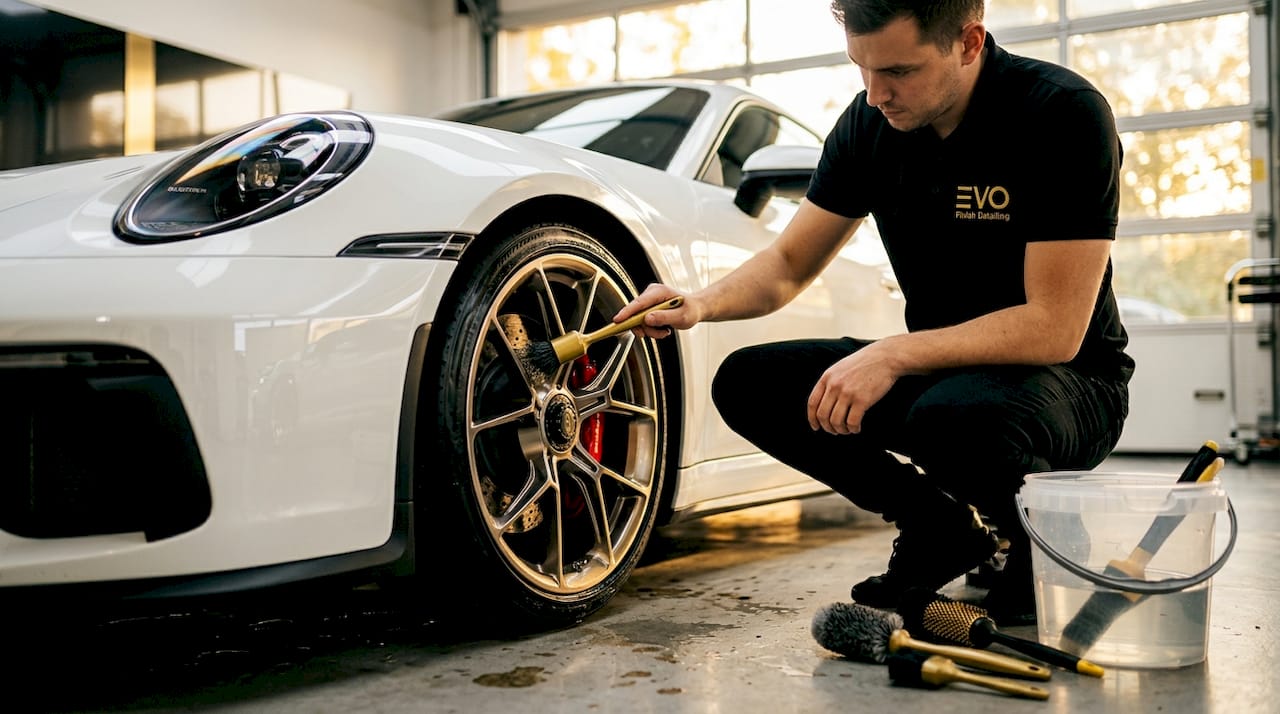
Brake dust is highly corrosive, combining metallic particles with carbon residue and heat-activated chemicals that etch into wheel surfaces if left to sit. On a sports car with high-performance braking systems, this happens faster and more aggressively than on a standard vehicle. Ferrous contamination from brake dust can permanently stain alloy, forged, or carbon ceramic wheel surfaces within days of exposure to moisture.
Here is how neglected wheel care stacks up against a proper maintenance schedule:
Factor | Regular wheel care | Neglected wheel care |
Appearance | Clean, polished, consistent finish | Staining, hazing, surface pitting |
Corrosion risk | Minimal with proper sealants | Progressive etching, permanent marks |
Brake dust buildup | Removed before bonding | Hardens and bonds to surface |
Safety | Unobstructed caliper inspection | Buildup can mask damage or heat cracks |
Long-term cost | Low, maintained finish | Potential refinishing or replacement |
For sports car owners, we recommend basic wheel cleaning every one to three weeks, depending on driving frequency and conditions. A full deep clean of inner barrels, calipers, and lug hardware should happen every two to three months. If you are considering upgrading sports car brakes as well, a detailed clean before installation gives you a clean baseline and shows any existing wear clearly.
Common mistakes we see regularly:
Using the same brushes on wheels that were used on body panels, transferring abrasive grit and chemicals.
Applying wheel cleaner to hot rotors or calipers, which causes chemical reactions and potential surface damage.
Missing the inner barrel, where brake dust accumulates thickest and causes the most long-term damage.
Using generic all-purpose cleaners that are either too alkaline or too acidic for specific wheel coatings.
Pro Tip: Always use a dedicated set of brushes for wheels and tires, clearly marked and stored separately from your paint-safe wash tools. Even microscopic brake dust particles embedded in a brush can cause fine scratching on painted surfaces if those tools cross over.
Paint correction and protection: Nuances and expert considerations
With wheels and tires properly maintained, refined paintwork is the next focus. This is where technique and restraint are critical, and where the most expensive mistakes are made.
Paint correction is the process of using machine polishers and abrasive compounds or polishes to remove surface-level defects including swirl marks, light scratches, water spot etching, and oxidation. It restores clarity and depth to the finish by leveling a microscopic layer of clear coat. Done correctly on the right surface, it produces results that look dramatically better in direct sunlight.
The critical word is “right surface.” Paint correction is not always desirable, especially when dealing with matte or satin finishes, vinyl wraps, or clear coats that have already been thinned through previous polishing sessions. Understanding when paint correction is needed requires inspection with a paint depth gauge before any machine touches the surface.
Situations where paint correction should be skipped or approached conservatively:
Matte or satin factory paint: Polishing removes the texture that creates the flat appearance, permanently ruining the finish.
Vinyl wraps: Abrasive polishing destroys wrap film. Use dedicated wrap-safe products only.
Thin clear coats: If gauge readings show less than 80-90 microns remaining, correction removes material you cannot afford to lose.
Recently corrected paint: Over-correcting across multiple visits accelerates clear coat wear without proportional benefit.
Factory fresh vehicles under warranty: Aggressive polishing within the first year can affect paint hardness and warranty coverage.
When it comes to detailing non-gloss finishes, the process is fundamentally different and requires specific non-abrasive products designed to clean and protect without altering the surface texture.
“The right process order and technique, not frequency, is what separates professional detailers from everyone else.”
After correction, protection is applied. Ceramic coatings offer the most durable long-term protection, bonding to the clear coat and creating a chemically resistant layer that repels water, UV radiation, and environmental contamination. A quality ceramic coating applied correctly can last two to five years with proper maintenance.
Interior detailing: Preserving luxury, function, and value
Detailing doesn’t stop at the exterior. The interior of a sports car has unique needs that require equal expertise, and in many cases, even more caution than the paintwork.
Sports car interiors combine materials you won’t find in standard vehicles: hand-stitched leather, Alcantara suede, exposed carbon fiber trim, magnesium paddle shifters, and sophisticated electronic controls built directly into surfaces. Each of these materials reacts differently to moisture, solvents, and cleaning agents. Using the wrong product even once can cause irreversible staining, surface hazing, or damage to sensitive electronic components.
Detailing is a structured process that addresses all surfaces, including interior and controls, and for sports cars, that means working methodically with products matched to each specific surface.
Key best practices for sports car interior detailing:
Alcantara: Use only dedicated Alcantara brushes and pH-neutral cleaners. Never saturate the material. Excessive moisture causes stiffness and can alter the texture permanently.
Leather: Condition regularly with lanolin-based leather products. Avoid silicone-based dressings that can dry leather out over multiple applications.
Carbon fiber trim: Wipe with a slightly damp microfiber only. Use a UV-protective sealant designed for interior carbon to prevent yellowing.
Electronic surfaces and screens: Use an electronic-safe, alcohol-free cleaner. Never spray directly onto screens or controls. Apply to the cloth first.
Vacuuming: Use a soft brush attachment and low suction around stitching and seams to avoid pulling threads or damaging hand-finished edges.
Frequent, careful interior care best practices prevent the gradual degradation that makes high-end interiors look tired and worn. For owners interested in interior upgrades for performance vehicles, maintaining factory surfaces in excellent condition preserves the baseline value that makes those upgrades worthwhile.
Our complete detailing packages cover every interior surface with the precision these vehicles require.
The expert’s edge: Why technique matters more than products
Here is our direct perspective, informed by detailing some of the most valuable sports cars in the region: the products matter far less than most people think.
The detailing industry spends enormous effort marketing premium products. Owners spend hundreds on high-end ceramic coatings, exotic waxes, and specialty chemicals. Then they apply them incorrectly, out of sequence, or on surfaces that weren’t properly prepared. The result is mediocre, regardless of the price on the bottle. As professional workflows demonstrate, process order and technique are the real differentiators between professionals and everyone else.
The highest-value skill in detailing is knowing when to stop. Most paint-related damage we correct comes from over-detailing: too much machine polishing, too many correction passes, or aggressive products applied too frequently. Owners chasing a perfect finish every single visit are unknowingly wearing down their clear coat faster than the environment ever would.
Restraint is a professional skill. A detailer who inspects your paint, measures clear coat depth, and recommends a maintenance wash instead of a full correction is showing you expertise, not cutting corners. The goal is your paint lasting twenty years looking great, not looking perfect for six months before needing a respray.
When hiring a detailer for your sports car, look for someone who asks about your finish type, checks paint depth before touching a machine, and explains their reasoning before starting. Our ceramic coating insights page gives you a clear picture of what that conversation should look like and what to expect from a professional approach.
Explore professional detailing options for your sports car
Your sports car represents a serious investment in performance and precision engineering. Protecting it requires the same standard of care.

We offer meticulous, sports car-specific detailing services that cover every stage of the process described in this guide. Whether your vehicle needs a full paint correction session, a ceramic coating for lasting protection, or a thorough interior refresh, we bring professional-grade results directly to you. View available detailing plans to find the right service level for your vehicle, explore our ceramic coating and paint correction options for in-depth protection, or book a mobile detail appointment and let us come to you. Guaranteed satisfaction, every time.
Frequently asked questions
What is included in a sports car detailing service?
A proper sports car detail covers exterior wash, decontamination, paint correction where appropriate, protection coatings, wheel and brake cleaning, and interior care for all surfaces. As car detailing specialists confirm, detailing addresses cleaning, refining, and protection across every surface of the vehicle.
How often should I get my sports car detailed?
A basic detail every one to three months is the standard recommendation, while wheel cleaning intervals of every one to three weeks are advised for performance vehicles with high brake dust output. Driving frequency and conditions should guide your specific schedule.
Should all sports cars receive paint correction during detailing?
No. Paint correction isn’t suitable for all finishes, and matte, satin, wrapped, or thin clear coat vehicles can be permanently damaged by aggressive polishing. A proper inspection before every session determines whether correction is appropriate.
Why is wheel and brake detailing important for sports cars?
Brake dust is corrosive and bonds to wheel surfaces quickly under heat and moisture, causing permanent etching and staining if left untreated. Regular, proper cleaning protects both the aesthetics and the long-term structural integrity of high-performance wheels.
Recommended
Comments