


Custom detailing explained: Transform your luxury car

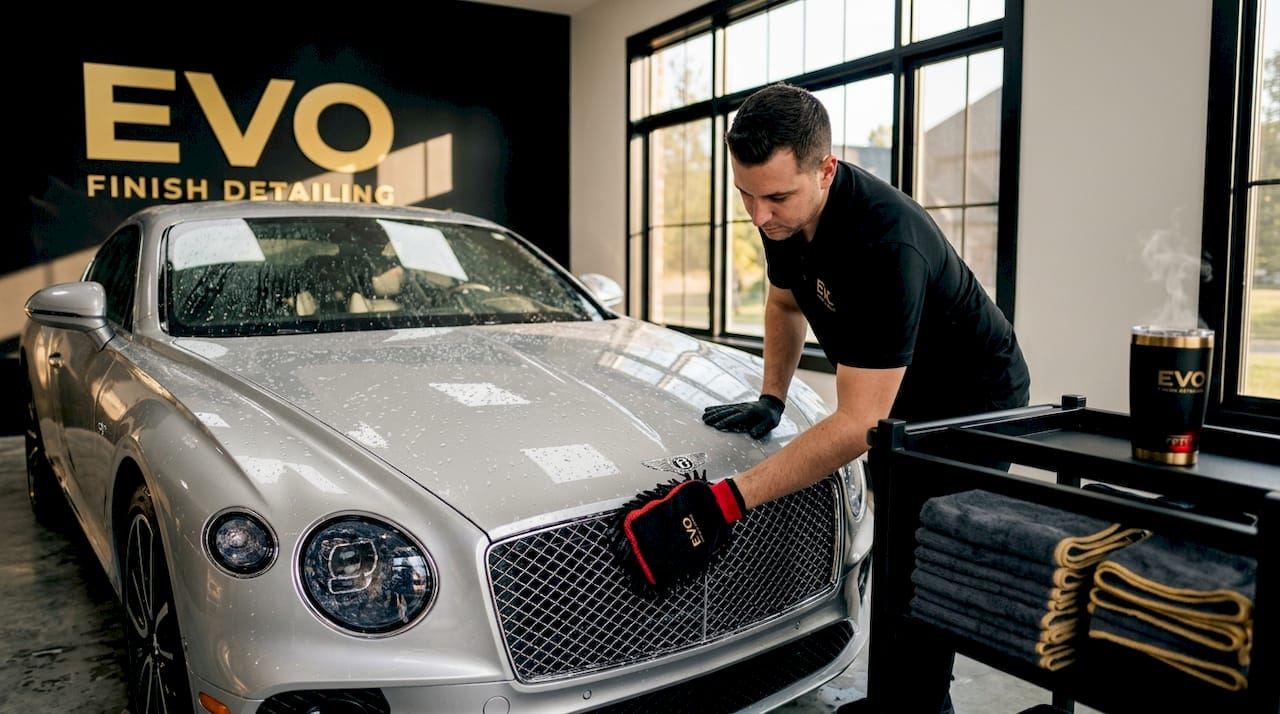
Most luxury car owners assume that running their vehicle through a high-end automated wash, or even a standard detail shop, gives them the level of care their investment deserves. It does not. Custom detailing is a fundamentally different service, one built around the specific needs of your vehicle rather than a one-size-fits-all process. Whether you own a classic Ferrari, a modern Bentley, or a pristine Range Rover, the difference between generic care and precision detailing becomes visible in the paint depth, the leather condition, and ultimately, in the resale price. This article covers what custom detailing actually is, how it works, and how to find the right provider.
Table of Contents
Key Takeaways
Point | Details |
Custom detailing defined | Custom detailing means highly personalized, expert-driven care designed to preserve and enhance luxury and high-value vehicles. |
Advanced protection options | Upgrades like ceramic coatings offer superior, lasting protection compared to traditional treatments. |
Clear comparison matters | Understanding the key differences helps you select the right care for your vehicle’s needs and value. |
Provider choice is crucial | Choosing a specialist detailer makes all the difference for results and long-term investment protection. |
What is custom detailing? Core concepts explained
Custom detailing is a personalized, vehicle-specific service that goes far beyond a basic wash and vacuum. It means a trained professional assesses your car’s actual condition, identifies its specific paint type, interior materials, and existing defects, and then builds a tailored service plan around those findings. Standard detailing follows a set checklist. Custom detailing follows your car.
For owners of luxury vehicles, this distinction matters enormously. A production car wash uses the same chemicals, the same brushes, and the same process on every vehicle. That works for a commuter sedan. For a matte-finish Lamborghini or a hand-stitched leather interior in an Aston Martin, generic products and abrasive brushes can cause real, lasting damage.
Key features that define custom detailing:
Personalized assessment before any work begins, examining paint condition, existing swirl marks, coating history, and interior material types
Advanced product selection based on your specific paint finish, whether gloss, matte, satin, or specialty
Focused preservation techniques designed to protect and maintain value rather than simply clean surfaces
One-on-one consultation so you can specify your concerns, from door jambs to undercarriage detail
Specialty services such as paint correction, ceramic coating, headliner restoration, and hand polishing
The custom detailing packages available at premium providers illustrate just how far this service can extend, covering everything from single-stage polish to full multi-day restoration work.
Feature | Custom detailing | Standard detailing |
Service personalization | Yes, vehicle-specific | No, set package |
Product selection | Tailored to paint/material | Generic products |
Paint correction available | Yes | Rarely |
Specialty coatings | Yes, ceramic, graphene | Wax or sealant only |
Interior material assessment | Yes, before service | No |
Consultation included | Yes | No |
Pro Tip: A truly custom detail begins with a conversation, not a price list. If a provider quotes you a flat rate before seeing your vehicle, that is a sign they are not adjusting their service to your car’s actual needs.
Inside custom detailing: Processes, techniques, and packages
Understanding what happens during a professional custom detail appointment removes any uncertainty about what you are paying for. The process is methodical, precise, and built to protect your vehicle’s condition both immediately and over time.
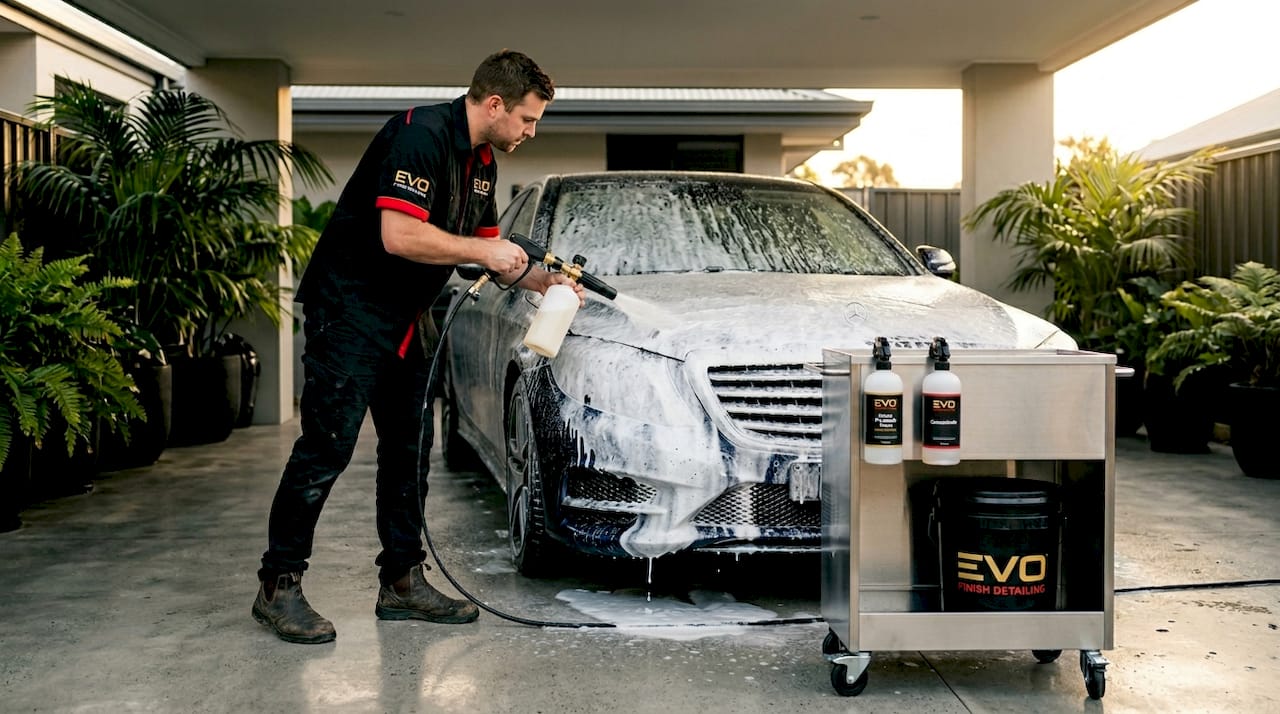
The exterior process typically starts with a thorough pre-wash, using a pH-neutral foam cannon to loosen contaminants without abrading the paint. A two-bucket hand wash follows, using microfiber mitts selected for your paint type. After drying, a clay bar treatment removes embedded contaminants that washing alone cannot reach, including industrial fallout, tar spots, and rail dust. This step is critical before any polish or coating is applied.
If paint correction is needed, a dual-action or rotary polisher is used with compound grades matched to the severity of swirl marks and scratches. For a vehicle with deep single-stage oxidation, multiple passes with progressively finer compounds restore gloss and clarity. For a daily driver with minor surface defects, a single finishing polish may suffice. The exterior refinement techniques used by skilled detailers are calibrated this precisely.
Interior work follows an equally detailed path. Leather seats receive a deep cleaning with pH-balanced cleaners, followed by a conditioning treatment that prevents cracking and color fade. Alcantara panels, common in high-performance vehicles, require specialized brushing techniques and dry-cleaning methods. Headliner rejuvenation addresses yellowing, staining, or sagging fabric without saturating the glue backing. The interior detailing specialties available from qualified providers cover these materials with the care they require.
A vehicle maintained through consistent, professional custom detailing retains significantly more of its resale value than one that has only received basic washes. For luxury cars specifically, condition documentation supported by detailing records can add thousands of dollars to a private sale or auction result.
Research on luxury vehicle markets confirms that documented maintenance and condition records, including professional detailing history, strengthen resale prices in the premium segment. For classic and collector vehicles, this effect is even more pronounced, as buyers and auction houses pay close attention to paint and interior condition history.
Sample workflow for a full custom detail appointment:
Pre-inspection and consultation with the vehicle owner
Pre-wash foam application and rinse
Two-bucket hand wash with appropriate microfiber media
Clay bar decontamination of all painted surfaces
Iron fallout remover treatment on wheels and lower panels
Paint correction (if required, single or multi-stage)
Application of protective coating (wax, sealant, or ceramic)
Interior vacuum and surface preparation
Material-specific cleaning: leather, alcantara, wood trim, metal accents
Final inspection and owner walkthrough
You can start scheduling custom detailing as soon as you understand which services apply to your vehicle’s current condition.
Custom detailing versus standard detailing: What’s really different?
Many luxury car owners have had a standard detail done and assumed they received premium care. In most cases, they did not. The difference between custom and standard detailing is not subtle. It shows in the quality of products used, the time invested per vehicle, and the long-term results on paint and interior surfaces.
Standard detailing follows a fixed process: wash, vacuum, wipe, and apply a quick sealant or spray wax. The same products and techniques are used regardless of whether the car is a Honda Civic or a Rolls-Royce Ghost. There is no paint assessment, no correction process, and no material identification for interior surfaces.
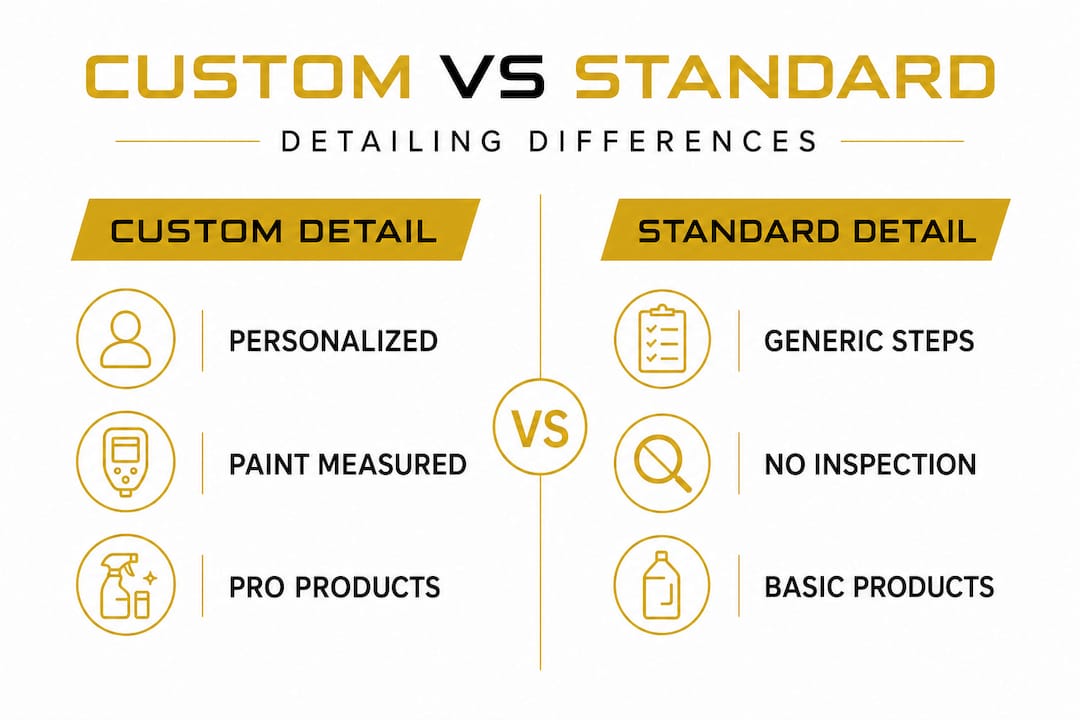
Custom detailing inverts that model. Every decision, from which wash media to use to which polish compound grade to select, is based on what your specific vehicle needs. Providers who offer detailing plans at the custom level build flexibility into every service tier.
Service element | Custom detailing | Standard detailing |
Pre-service vehicle inspection | Always | Never |
Paint thickness measurement | Often included | No |
Iron decontamination | Yes | No |
Clay bar treatment | Yes | Rarely |
Paint correction | Yes, multi-stage | No |
Ceramic or specialty coating | Available | No |
Leather conditioning | Yes, material-specific | Generic wipe |
Headliner restoration | Available | No |
Post-service walkthrough | Yes | No |
Major advantages for high-value vehicles:
Preservation of rare factory finishes, including matte, satin, and special-edition colors that react poorly to standard chemicals
Documented condition improvement that supports insurance valuations and resale negotiations
Material-appropriate care for hand-stitched leather, carbon fiber trim, and exotic wood accents
Custom coating applications matched to your garage conditions and driving frequency
The signature complete detail represents what a truly bespoke service looks like when every element is calibrated for your specific vehicle.
Pro Tip: Ask any provider whether they measure paint thickness before polishing. A quality detailer checks this to avoid cutting through clear coat on vehicles that have already been polished multiple times. If they do not know what a paint gauge is, walk away.
Advanced protection: Custom detailing and modern paint technologies
The most significant advancement in custom detailing over the past decade is the integration of high-tech paint protection directly into the detailing process. Ceramic coatings and paint correction are no longer optional extras for enthusiasts. For classic, exotic, or high-value vehicles, they are the standard of responsible ownership.
Ceramic coating is a liquid polymer applied to exterior surfaces that chemically bonds with the factory paint, creating a semi-permanent, hydrophobic layer. Unlike wax, which sits on top of the paint and degrades within weeks, a quality ceramic coating lasts two to five years under normal conditions. It resists UV oxidation, chemical etching from bird droppings and tree sap, and light surface contamination. The ceramic coating options available for luxury vehicles represent serious, long-term investment protection.
Paint correction is the process of removing surface defects, including swirl marks, water spot etching, fine scratches, and oxidation, before any protective coating is applied. Applying ceramic over uncorrected paint locks those defects in permanently. This is why the sequence matters. Correct first, protect second.
Protection type | Durability | Hydrophobic effect | UV protection | Maintenance |
Carnauba wax | 4 to 8 weeks | Moderate | Low | Monthly application |
Paint sealant | 3 to 6 months | Good | Moderate | Seasonal application |
Ceramic coating | 2 to 5 years | Excellent | High | Annual maintenance wash |
Graphene coating | 3 to 7 years | Superior | Very high | Annual maintenance wash |
Benefits of adding advanced paint protection to your custom detail package:
Maintains the deep gloss of high-end factory paint for years without regular polishing
Protects specialty finishes like matte and satin from contamination that would require costly correction
Reduces the frequency and cost of future detailing appointments
Provides documented protection history that supports vehicle valuations
Guards against the UV damage that causes paint oxidation on vehicles stored outdoors
If you are evaluating the cost of advanced protection, explore payment options for upgrades before your appointment to plan accordingly.
Choosing your custom detailer: Key considerations for discerning vehicle owners
Finding the right custom detailing provider is not about finding the cheapest price or the busiest shop. For a vehicle worth six or seven figures, the selection process should be as careful as choosing a watchmaker for a Patek Philippe.
Steps to vet and select a custom detailer:
Review their portfolio, specifically for vehicles in your class. A detailer experienced with late-model sports cars may not have the knowledge base for a classic vehicle with original lacquer paint.
Ask about product lines. Reputable providers use professionally sourced compounds, coatings, and interior care products, not consumer-grade alternatives.
Confirm certifications. Look for training from recognized coating manufacturers or professional detailing associations.
Request a pre-service assessment. Any professional will inspect your vehicle before quoting. If they skip this step, their quote is not based on your actual car.
Check for insurance and liability coverage. Accidents are rare with skilled detailers, but when your vehicle is worth serious money, coverage matters.
Read reviews with specificity. Look for reviews that mention specific vehicles, specific services, and specific outcomes rather than generic praise.
A provider with verifiable experience across luxury vehicles will give you transparent information about what your car needs, what products they will use, and what results you can realistically expect.
Pro Tip: Red flags in a detailing provider include pressure to upsell before inspection, vague descriptions of products used, no fixed workspace or mobile setup without proper equipment, and an unwillingness to show you the products they plan to use on your vehicle.
When you are ready to commit to real precision care, book your detailer with a provider who has demonstrated results with vehicles like yours.
Why luxury car care demands more than a standard detail
Here is what most mainstream detailing advice gets consistently wrong: it treats all cars as roughly equivalent and all detailing as roughly equivalent. The tips written for someone protecting a family SUV simply do not apply to a collector vehicle with original paint or a modern exotic with factory PPF and a matte topcoat.
We have seen firsthand what happens when luxury and classic vehicles receive the wrong care. Abrasive automatic washes leave micro-marring in soft European clear coats. Generic leather conditioners dry out hand-stitched Nappa leather because they are formulated for corrected-grain material. Standard polish compounds applied without paint thickness measurements cut through clear coat on vehicles that have already had multiple detail sessions. These are not hypothetical risks. They are outcomes we have corrected for real clients who came to us after a previous provider caused damage.
The uncomfortable truth about luxury car care is that the premium for a true custom detail is not about comfort or status. It is about technical necessity. A 1965 Porsche 911 with original lacquer paint cannot be polished the same way as a 2023 McLaren with a factory ceramic base coat. A carbon fiber hood requires different decontamination chemistry than a steel panel. These are technical realities that require specialized knowledge, and that knowledge is not common in standard detailing.
The comprehensive detail strategies we apply reflect years of hands-on work with vehicles where mistakes are not recoverable with a standard touch-up. For owners who have invested seriously in their vehicles, that level of care is not a luxury. It is the only responsible choice.
Experience world-class custom detailing with Evo Finish
At Evo Finish, we specialize in precision detailing for luxury, classic, and exotic vehicles across Truckee, Northern Nevada, and Lake Tahoe. Every service starts with a thorough assessment of your vehicle, and every product decision is made with your specific make, model, and finish in mind.
Whether you are protecting a modern sports car with advanced ceramic coating, restoring a classic to concours condition, or simply maintaining a vehicle you take serious pride in, we deliver meticulous results with guaranteed satisfaction. WE COME TO YOU. Book your custom detail today and see exactly what precision care looks like for a vehicle that deserves it. You can also explore pricing and plans to find the right service level for your vehicle and schedule.
Frequently asked questions
How often should I get custom detailing for my luxury vehicle?
Most luxury car owners benefit from custom detailing every three to six months, depending on driving conditions, exposure to elements, and whether a ceramic coating is in place to extend protection between appointments.
Does custom detailing affect my car’s resale value?
Yes. Custom detailing preserves paint condition, interior materials, and overall presentation, all of which directly support and sometimes increase the resale value of luxury vehicles, especially when paired with documented service records.
What is included in a premium custom detail package?
Premium custom detail packages typically include paint correction, ceramic coating application, leather conditioning, interior deep cleaning, decontamination treatments, and a post-service walkthrough with the owner.
How does ceramic coating differ from waxing?
Ceramic coating chemically bonds to the paint surface and lasts two to five years, offering far greater durability and UV protection than traditional wax, which degrades within weeks and requires frequent reapplication. See what ceramic coating protection looks like in practice.
Can I request specific products or methods for my custom detail?
Absolutely. Custom detailing is built around your vehicle and your preferences. You can specify coating brands, request particular interior care products, or flag areas of concern before the service begins.
Recommended
Comments