


Roles in Professional Detailing: Your Career Breakdown

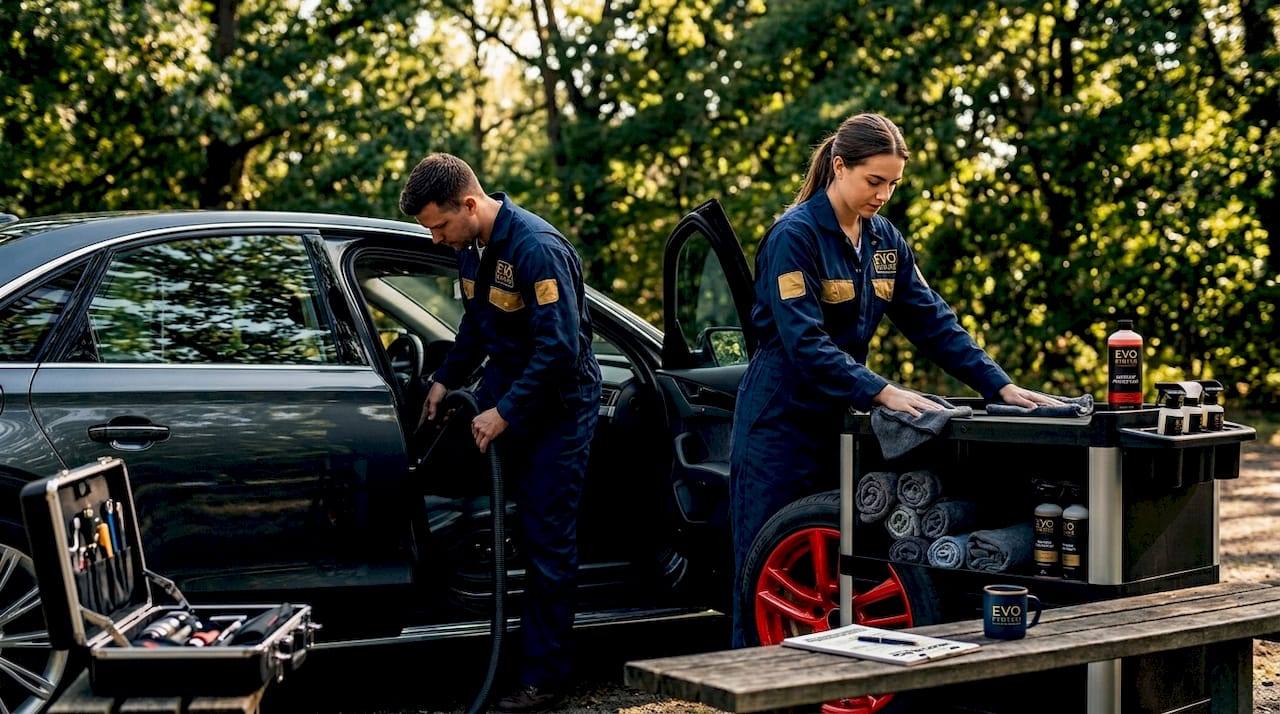
Most people assume a car detailer just washes cars. That assumption costs people real career opportunities. The roles in professional detailing span a wide spectrum, from entry-level technicians handling interior vacuuming to ceramic coating specialists commanding premium pay, to shop managers running entire teams and business owners scaling past $10K per month. If you are in this industry or trying to break into it, knowing exactly what each role looks like, what it requires, and where it leads is the difference between drifting through jobs and building a deliberate career.
Table of Contents
Key takeaways
Point | Details |
Detailing roles are highly varied | Positions range from entry-level wash techs to paint correction specialists and business owners. |
Specialization drives higher pay | Technicians trained in ceramic coating and paint correction access better compensation and career advancement. |
Management requires different skills | Detail managers focus on operations, quality control, and staffing, not hands-on cleaning. |
Business roles demand systems thinking | Scaling a detailing business requires lead generation, client retention, and operational documentation. |
Career growth is evidence-based | Employers and clients look for documented work quality, certifications, and consistent recommendations. |
Roles in professional detailing: the core technician
The foundation of every detailing operation is the detailing technician. This is where most careers begin, and it is a role with more technical depth than most outsiders realize.
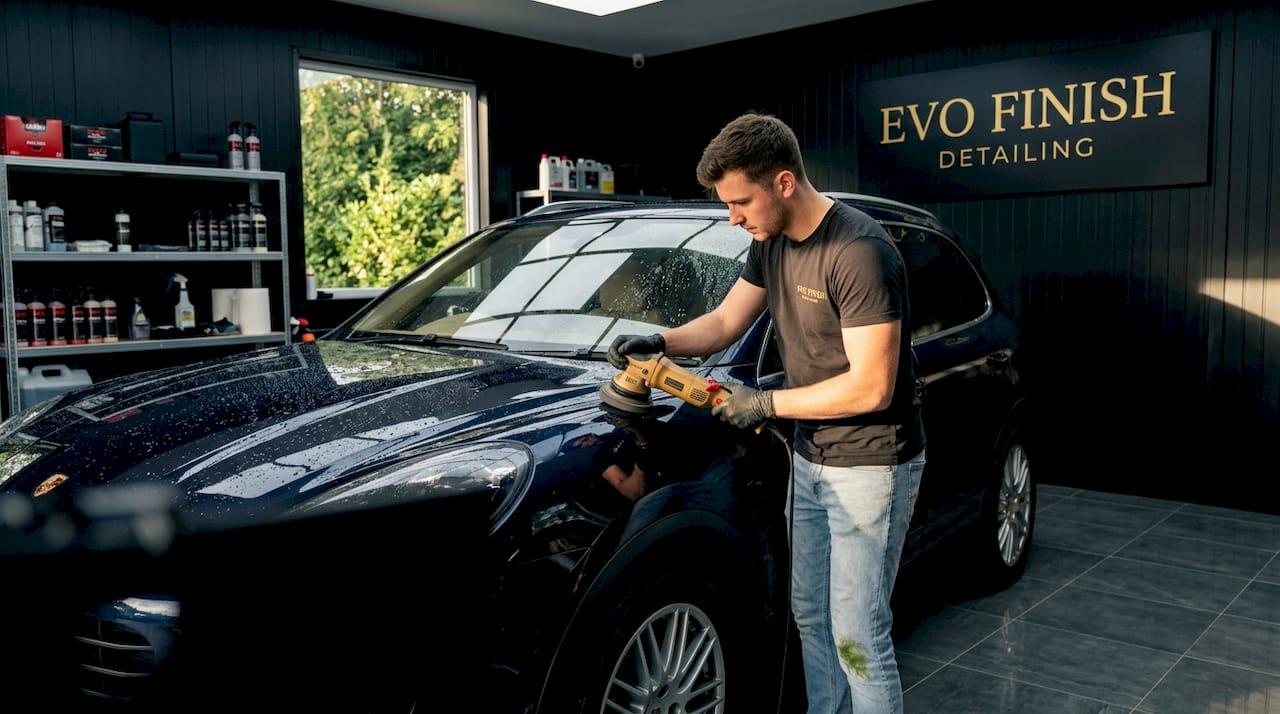
Core tasks include washing, drying, polishing, waxing, vacuuming, dry cleaning upholstery, applying stain removers, washing tires, polishing windows, and performing minor scratch repairs. That list alone separates professional detailing from a simple car wash. A detailer is not running vehicles through a machine. They are working each surface by hand with specific products and specific techniques for specific materials.
Beyond cleaning, the detailer’s role includes waxing, polishing, engine detailing, rust treatment, stain removal, and odor elimination. Each of these tasks requires product knowledge. Using the wrong chemical on a leather seat or a matte finish panel causes real damage. That is why attention to detail is not just a soft skill in this trade. It is a technical requirement.
Detailing technicians also carry quality control responsibilities. Before a vehicle leaves the shop, they inspect their own work and often a colleague’s work. This habit of meticulous inspection is what separates a professional finish from an average one.
Here is a breakdown of what a core detailing technician handles on a typical workday:
Exterior wash and hand dry using microfiber towels
Clay bar treatment to remove surface contaminants
Machine or hand polish to correct minor swirl marks
Application of wax or sealant for paint protection
Interior vacuum, including seats, carpet, and trunk
Upholstery cleaning and conditioning
Window cleaning inside and out
Tire and wheel cleaning and dressing
Final inspection for missed spots or product residue
The physical and technical demands of this role are real. Detailers stand for long hours, perform repetitive motions, and must stay focused on quality throughout. If you thrive in hands-on environments and take personal pride in a flawless result, this role is genuinely satisfying.
Pro Tip: Build a phone portfolio from day one. Photograph every vehicle before and after your work. This documentation becomes proof of your skill when you apply for advanced roles or price higher-end services.
Specialized and advanced detailing roles
Once a technician has mastered the fundamentals, the next career step is specialization. These professional detailing positions are where compensation and reputation separate sharply from entry level.
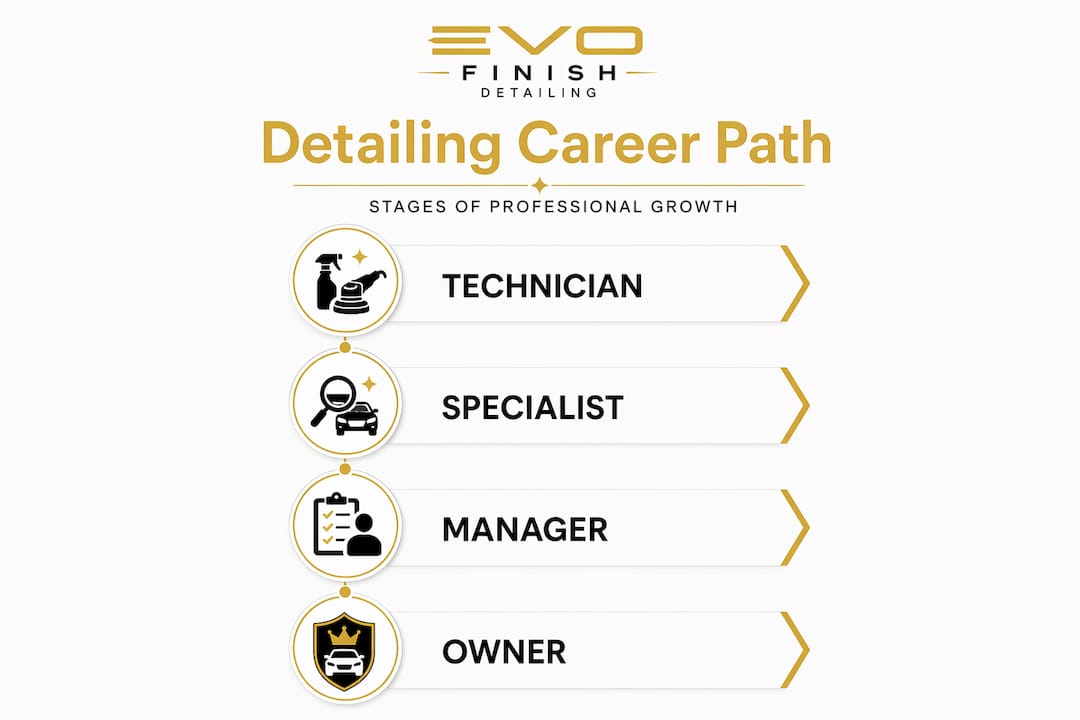
The most sought-after specializations in auto detailing right now are paint correction, ceramic coating application, and mobile detailing operations. Each one demands a different skill set and, in most cases, specific product training or certification.
Here is how the major specialized roles compare:
Role | Core Skills | Work Setting | Earning Potential |
Paint correction specialist | Machine polishing, compound/polish selection, paint depth reading | Shop or mobile | High |
Ceramic coating applicator | Surface prep, coating chemistry, curing environment control | Climate-controlled shop | High |
Mobile detailing technician | Full-service setup, water and power self-sufficiency, time management | Customer location | Moderate to high |
Detailing technician (generalist) | Interior and exterior full-service work | Shop or dealership | Moderate |
Paint correction specialists use advanced techniques like paint correction that require specific training and significantly enhance career prospects. This work involves cutting away microscopic layers of clear coat to eliminate scratches, oxidation, and swirl marks. Get it wrong and you burn through the clear coat entirely. That level of risk is why trained specialists charge significantly more than generalists.
Ceramic coating is a long-term protective layer applied over paint. It bonds chemically to the surface and can last years with proper maintenance. This service commands premium pricing and clients who invest in it tend to return and refer. Mobile detailers, on the other hand, operate as a full service out of a van or trailer. Mobile detailing services include hand washing, waxing, tire cleaning, vacuuming, shampooing, dashboard and seat cleaning, and odor removal, all performed at the customer’s location. The logistical challenge is real: you must carry all your water, power, and products with you.
Start with paint correction training before pursuing ceramic coating certification. The prep work for coatings is identical to correction work, so the skills transfer directly.
Get hands-on experience with a mentor before working solo on high-value vehicles. Mistakes on exotic paint are expensive.
Study the products you apply, not just the technique. Product chemistry knowledge makes you a better applicator and a more credible consultant to clients.
Build a specialty portfolio with documented before-and-after results at every stage of a correction or coating job.
Consider mobile detailing as a lower-overhead way to launch a specialized service without the cost of a shop lease.
Leadership and management roles in detailing shops
Moving into management means shifting your focus from the vehicle to the team. This is where many detailers hit a wall because the skills that make a great technician do not automatically translate to running a crew.
Automobile detail manager responsibilities include hiring, training, scheduling, delegation, quality inspection, labor cost management, and customer satisfaction oversight. That is a broad mandate. A detail manager at a dealership or a high-volume shop is accountable for output quality, throughput speed, and staff retention, all at the same time.
The toughest part of transitioning from technician to manager is letting go of the work itself. Many detail managers try to keep working on vehicles while managing a team, and it pulls them in both directions without doing either well. The most effective managers I have seen learn to inspect work rather than perform it.
Pro Tip: If you are stepping into a management role, create a simple checklist for every vehicle type your shop services. Standardized inspection checklists reduce comebacks, train new staff faster, and protect your quality standards when you are not watching every car yourself.
Key responsibilities that define this role include:
Recruiting and onboarding detailing staff with clear performance standards
Creating and managing daily production schedules
Conducting final quality inspections before vehicle delivery
Tracking labor hours against revenue to maintain profitability
Communicating directly with customers about service timelines and results
Coaching technicians on technique improvements and product use
Maintaining inventory of chemicals, tools, and equipment
Detail managers are expected to use systems for delegation and tracking while balancing quality and productivity goals. In practice, this means software for job tracking, written SOPs for each service tier, and regular one-on-ones with your detailers to catch problems before they become patterns. Managers who document their team’s work and consistently make recommendations based on data are the ones who retain good staff and impress owners.
Business and entrepreneurial roles in detailing
Running a detailing business puts you in a role that most detailing job descriptions do not prepare you for. You are no longer primarily a technician. You are a marketer, a salesperson, a systems builder, and a client manager, often all in the same day.
Detailing business success depends on marketing, client management, quality delivery, and operational systems, with owner bottlenecks being the most common reason businesses stall. That last point is worth repeating: the owner is usually the bottleneck. If every decision, every quality check, and every client call runs through you, the business cannot grow past what your personal hours allow.
Here is how the core functions of a detailing business break down across roles:
Business Function | Responsibility | Impact on Revenue |
Lead generation | Paid ads, Google profile, referrals | Direct: fills the schedule |
Sales and quoting | Consultation, upselling services | Direct: increases average ticket |
Service delivery | Technical execution and quality | Direct: drives retention |
Client retention | Follow-up, loyalty programs, reviews | Compounding: reduces acquisition cost |
Operations and systems | SOPs, scheduling, inventory | Indirect: protects margin and time |
Scaling past consistent revenue requires systematized lead nurture, defined sales processes, delivery quality standards, retention strategy, and operations management. The owners who build that infrastructure early grow faster and burn out less.
If you are in this role or moving toward it, the single highest-leverage skill you can develop is documentation. Write down how every service gets done. Then train someone else to do it to that standard. That is the only path from solo operator to actual business.
How understanding detailing roles guides your career
Whether you are just entering the industry or looking to move up, clarity about what each role actually requires saves you years of trial and error. Matching your strengths and interests to the right position is the starting point for genuine career growth in auto detailing.
Here is what you should be building toward, regardless of which role you are targeting:
Document your work with before-and-after photos and client feedback
Pursue product-specific training from brands like Meguiar’s, Chemical Guys, or Gtechniq for credibility
Seek out certifications in paint correction and coating application as your skills grow
Build relationships with other detailers through forums, regional detailing groups, and trade events
Stay current on product developments like graphene coatings and waterless wash systems, as emerging techniques continue to reshape what professional detailing positions require
The detailing industry is growing and professionalizing. Employers and clients now look for evidence of skill, not just experience. Understand what professional car detailing actually means at each service level, and you position yourself to compete for better roles and better clients.
My honest take on where detailing careers are heading
What I’ve seen shift in the last few years is the expectation level at every tier of this industry. Entry-level technicians used to need a good work ethic and basic product knowledge. Now, shops that run at a high level expect new hires to understand inspection protocols and product chemistry from day one.
In my experience, the biggest missed opportunity for detailers is specialization. Most people stay generalists too long. Generalist detailers are easier to replace and harder to pay well. A technician who can perform a flawless multi-stage paint correction or apply a ceramic coating with documented prep and curing standards is a different hire entirely.
What I’ve learned about the management transition is that it breaks people who are not ready for the people side of the job. Being meticulous about a vehicle is not the same as being patient with a struggling technician at 4 PM on a Friday. Leadership in detailing requires you to invest in your team the same way you invest in your paint correction process. Systematically. Consistently.
For anyone looking at the entrepreneurial path, I would say this: build your systems before you need them. The detailers who scale are not the ones who worked the hardest. They are the ones who built processes that work without them standing over every job.
— EVO
Work with Evofinish: professional detailing done right
At Evofinish, we bring meticulous mobile auto detailing directly to you. No drop-offs. No waiting rooms. We come to you with the tools, products, and precision to deliver a flawless result every time.

Whether you want a thorough interior and exterior detail or you are ready to invest in lasting protection with ceramic coating and paint correction, our team has the training and dedication to get it done right. We specialize in the kind of meticulous, guaranteed-satisfaction work that keeps clients coming back and recommending us to everyone they know. Ready to experience what a true professional detail feels like? Book your detail today and let us show you the Evofinish standard.
FAQ
What are the main roles in professional detailing?
The main roles in professional detailing include entry-level detailing technicians, paint correction and ceramic coating specialists, mobile detailers, detail shop managers, and detailing business owners. Each role carries distinct responsibilities and requires different levels of skill and experience.
What does a detailing technician do?
A detailing technician performs exterior and interior cleaning, polishing, waxing, stain removal, and quality inspections. Core responsibilities include washing, vacuuming, tire cleaning, window polishing, and minor scratch repair.
What skills do you need for careers in car detailing?
Careers in car detailing require physical endurance, attention to detail, knowledge of detailing products and tools, and strong customer communication. Detailers must understand which products and techniques apply to specific surfaces to avoid damage.
How does a detail manager differ from a detailer?
A detail manager oversees hiring, scheduling, quality control, and labor cost management rather than performing hands-on cleaning. The role focuses on team performance and operational standards rather than individual vehicle work.
How do detailers advance to higher-paying roles?
Detailers advance by specializing in services like paint correction and ceramic coating, building a documented portfolio of completed work, and pursuing product-specific certifications. Advancement is evidence-based: consistent quality and client recommendations drive both pay increases and management opportunities.
Recommended
Comments