


How to Detail Exotic Cars Without Damaging Them

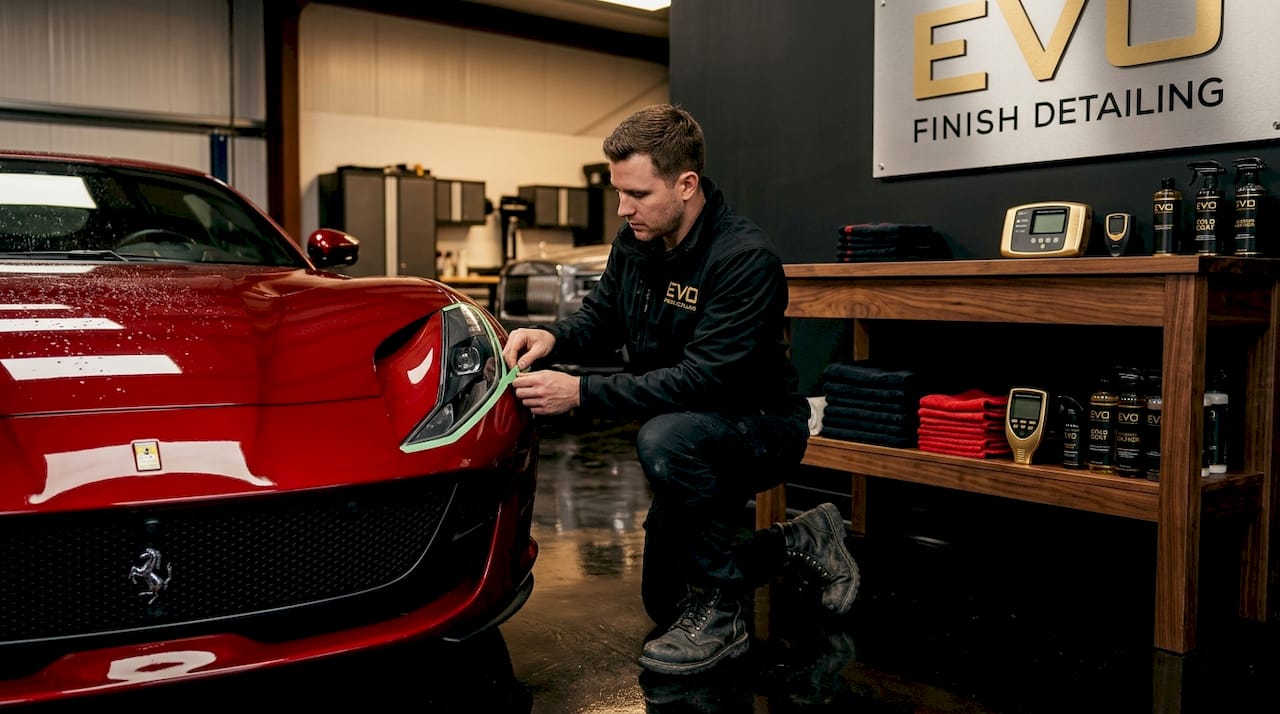
Knowing how to detail exotic cars is not the same as knowing how to detail any car. One wrong product, one aggressive pass with a polishing pad, and you can burn through a factory clear coat that costs thousands to restore. Exotic cars carry delicate paint systems, rare interior materials, and finishes that demand precision at every step. This guide covers the exact tools, techniques, and sequences we use at Evofinish to detail high-end vehicles safely and deliver results that hold up long after we leave the driveway.
Table of Contents
Key takeaways
Point | Details |
Use a paint thickness gauge | Measure paint depth before polishing to avoid burning through thin or previously repaired clear coat. |
Match products to materials | Use pH-balanced shampoos for paint, dedicated Alcantara cleaners for suede-like surfaces, and leather-specific conditioners for interiors. |
Wash in shade, always | Direct sunlight causes water spots and accelerates product evaporation, which damages exotic paint finishes. |
Ceramic coating protects your work | Applying a professional ceramic coating after detailing locks in protection and dramatically reduces future maintenance effort. |
Know when to stop and call a pro | Deep scratches, paint below 80 microns, and exotic interior stains require professional correction, not DIY polishing. |
How to detail exotic cars: the right tools first
Before you touch the paint, your tool selection determines whether you protect the car or damage it. Exotic vehicles do not forgive shortcuts, and that starts with what you put in your hand.
The core toolkit for detailing a luxury or exotic vehicle includes:
Two-bucket wash system with grit guards to keep abrasive particles away from your wash mitt
Premium microfiber wash mitts made from long-pile material that lifts contaminants without grinding them into paint
pH-balanced car shampoo that will not strip existing wax or sealant layers
Paint thickness gauge to read clear coat depth before any machine polishing begins
Dual-action (DA) polisher rather than a rotary, which generates less heat and reduces risk on delicate finishes
Soft detailing brushes with boar or synthetic bristles for wheels, emblems, and tight panel gaps
High-quality microfiber drying towels rated at 500+ GSM to absorb water without dragging
The paint thickness gauge deserves special attention. Paint gauges reveal hidden bodywork and tell you exactly how much clear coat you have left before compounding becomes dangerous. One technical note: hold the probe perpendicular to the surface panel. On curved sections like fenders and door corners, even a slight angle skews your reading and can lead to a false sense of safety.
When it comes to cleaning agents, different surfaces require different formulas:
Surface | Recommended product type | What to avoid |
Exterior paint | pH-neutral car shampoo | Dish soap, alkaline degreasers |
Wheels | Dedicated wheel cleaner (acid-free) | Harsh iron removers on bare aluminum |
Glass | Automotive glass cleaner | Ammonia-based window sprays |
Leather interior | pH-balanced leather cleaner and conditioner | Bleach, alcohol-heavy sprays |
Alcantara / suede | Specialized Alcantara cleaner | Water saturation, stiff brushes |
Pro Tip: Store your microfiber towels separately from other shop cloths and wash them with microfiber-safe detergent. One contaminated towel introduced to an exotic’s paint can cause swirl marks that require an entire correction cycle to fix.
Step-by-step exterior detailing process
The exterior is where most detailing mistakes happen. Here is the exact sequence we follow at Evofinish for any exotic vehicle.
Pre-rinse the vehicle with a low-pressure rinse to loosen and float off loose dirt before any contact washing begins.
Wash in a shaded area using the two-bucket method. Washing in direct sunlight causes rapid water evaporation and mineral deposits that etch into clear coat.
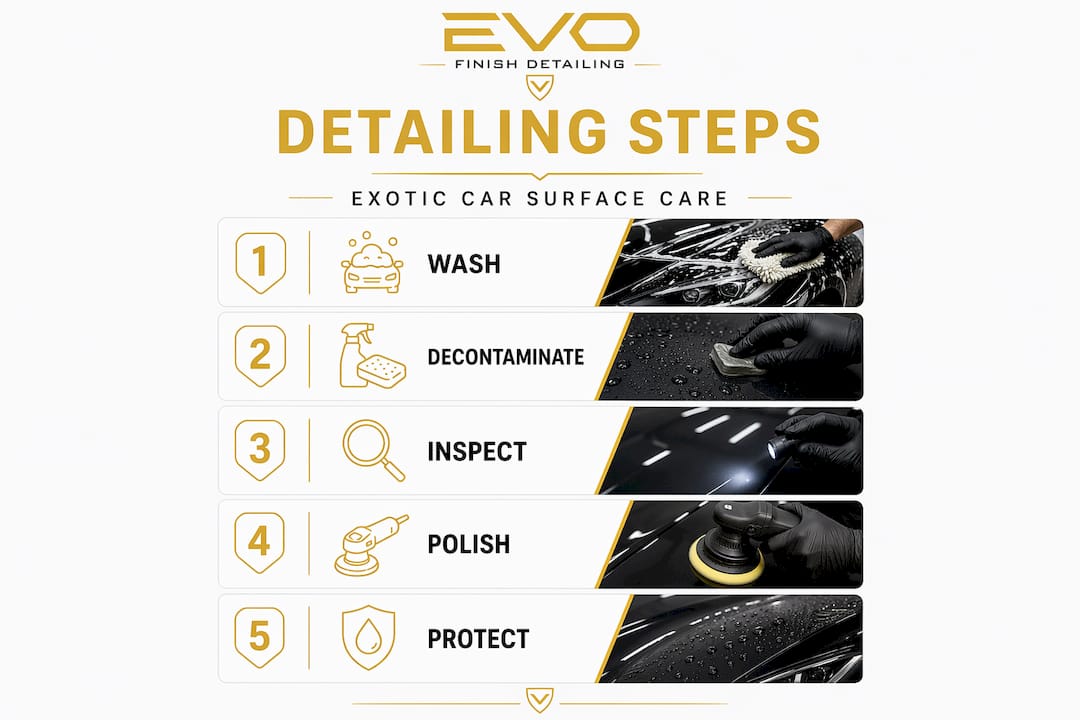
Decontaminate the paint with an iron fallout remover spray, then follow with a clay bar or clay mitt on lubricated paint to pull bonded contaminants the wash cannot remove.
Measure paint thickness on all major panels before using any machine polisher. Factory paint on modern vehicles typically reads 95 to 125 microns. Readings below 80 microns signal a panel too thin to safely polish.
Perform paint correction with a DA polisher and the mildest compound or polish that addresses the defect. Work in small sections, keep pad speed moderate, and check your results in bright light frequently.
Apply ceramic coating or paint sealant to lock in the corrected finish. Ceramic coatings provide durable protection and gloss enhancement that holds up far longer than traditional wax.
Final wipe-down with a clean, plush microfiber towel using zero pressure. Let the product do the work.
One thing that separates proper exotic car detailing from standard washing is the polish selection. High-quality microfiber towels and low-abrasion compounds are not optional upgrades. They are what keep you from creating new problems while correcting old ones.
Pro Tip: Do your final paint inspection with a focused LED light held at a low angle. Overhead lighting misses swirl marks and buffer trails that will be glaringly obvious once the car sits in sunlight.
Interior detailing for exotic materials
The interior of a Lamborghini, Ferrari, or McLaren is not just leather and plastic. You are working with Alcantara headliners, carbon fiber trim, polished aluminum accents, and hand-stitched leather that can run thousands of dollars per panel. Using harsh chemicals or abrasive tools on these surfaces causes irreversible damage.
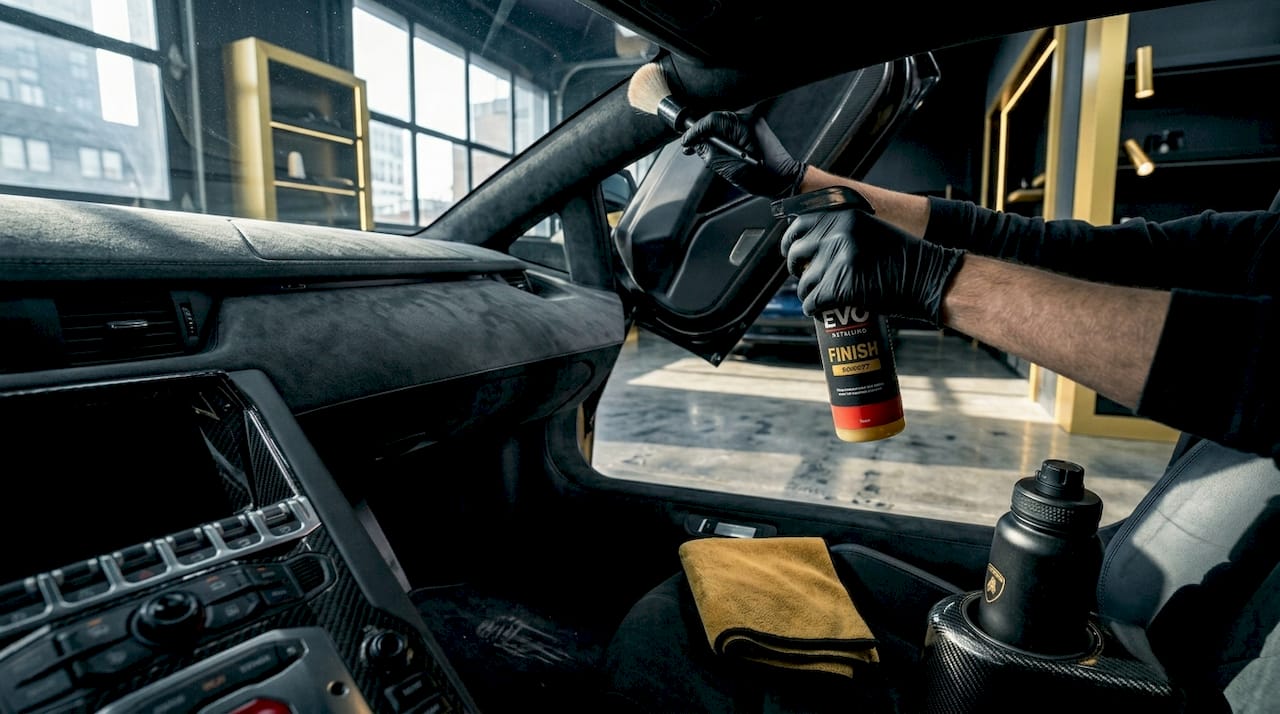
Here is a reliable process for exotic interior detailing:
Do:
Vacuum all surfaces with a soft brush attachment before applying any product
Use a dedicated Alcantara brush cleaner in short, straight strokes (never circular)
Apply leather cleaner with a foam applicator, let it dwell briefly, then wipe with a soft microfiber
Follow leather cleaning with a pH-balanced conditioner to prevent drying and cracking
Clean carbon fiber trim with a damp microfiber and dry immediately to prevent water marks
Do not:
Spray product directly onto any surface. Always apply to your applicator first
Use interior all-purpose cleaners on Alcantara or fine leather
Scrub stitching with stiff brushes, which fray threads over time
Use silicone-based dressings on steering wheels or pedals, which create dangerous slip
For odor control, activated charcoal bags work well for storage situations. If odor is embedded in Alcantara, a professional-grade enzyme cleaner applied conservatively with a microfiber cloth is the safest approach. You can also explore deep interior cleaning techniques for more coverage on reaching tight spaces and hard-to-clean surfaces.
Pro Tip: After conditioning leather, buff the seats with a clean, dry microfiber cloth using light pressure. This removes any excess conditioner that would otherwise transfer to clothing.
Reading and repairing paint imperfections
Not every scratch is treatable with polish. Getting this wrong costs you clear coat you cannot get back.
The first test is the fingernail test. If your fingernail catches in the scratch, the damage has gone through the clear coat into base coat or primer. Polishing will not fix it. It will only make the area shinier around the defect, which actually draws more attention to it.
Use this table to match scratch type to the correct response:
Scratch type | Depth | Correct treatment |
Swirl marks / light marring | Clear coat surface only | DA polishing with fine compound |
Single-panel scratch (fingernail does not catch) | Clear coat mid-depth | DA polishing with medium compound |
Deep scratch (fingernail catches) | Into base coat | Touch-up paint or professional correction |
Previous repair area (gauge reads 150+ microns) | Thick repaint over damage | Polish with extreme caution, minimal passes |
Bare metal (no paint reading) | Full repaint needed | Professional body shop repair |
The paint thickness gauge is your decision-making tool here, not just a precaution. Readings above 150 microns suggest a previous repair, which means you may be polishing through an applied clearcoat over a repainted surface rather than factory paint. That changes your approach entirely.
For exotic and classic car owners, collector communities increasingly value original factory paint patina over aggressive restoration. A car with original factory paint in fair condition is often worth more than one that has been fully resprayed. Polish and protect. Avoid compounding away history.
Post-detailing maintenance that actually lasts
A full detail is an investment. What you do in the weeks following determines how long that investment holds.
Key habits that preserve your detail:
Wash frequency: Once every two weeks using the two-bucket method with pH-neutral shampoo. Avoid automatic car washes entirely since the brushes and chemicals are incompatible with exotic finishes.
Touchless rinse between washes: A quick waterless wash spray and clean microfiber removes light dust without putting the car through a full wash process.
Covered storage: A breathable, cotton-lined car cover prevents dust accumulation, minor scratches from airborne debris, and UV fade during storage.
Ceramic maintenance spray: After each wash, apply a ceramic maintenance spray to keep the hydrophobic layer active. This is especially useful on black cars, where water spots and light contamination show immediately.
Chip repair: Address paint chips immediately with touch-up paint before exposed primer absorbs water and causes rust or lifting.
Appropriate washing schedules and protective film use are among the most effective ways to extend the life of your detailing work. The detail itself is not the hard part. Consistent upkeep is.
Knowing when to bring in a professional matters too. If you notice worsening swirl marks after self-washing, haze developing in the clear coat, or leather that is starting to crack despite conditioning, those are signs you need a full professional correction cycle rather than more DIY maintenance.
My perspective on exotic car detailing
I’ve seen exotic car owners spend tens of thousands on their vehicles and then hand them to a detailer who uses a random orbital with a heavy-cut compound and a gas station chamois to dry. The result is a swirled, hazy finish that looks worse in direct sunlight than before the detail began.
What I’ve learned from working with these vehicles is that the philosophy matters as much as the technique. Preservation almost always beats restoration. When you have a car with original factory paint still intact, aggressive compounding unnecessarily removes microns of clear coat that you cannot put back. The goal should be to protect what is there, not to chase a showroom shine at the cost of the coating’s longevity.
The paint thickness gauge changed how I approach every car. Measuring first removes guesswork completely. You know what you have, you know what you can safely do, and you make decisions based on data rather than assumptions. That one tool has saved more exotic paint jobs than any product I use.
My take: patient, measured detailing on an exotic is always better than fast, aggressive detailing. Slow down, read your surface, use the right products, and the results speak for themselves.
— EVO
Let Evofinish protect your exotic car
At Evofinish, we specialize in precision detailing for exotic, luxury, and high-performance vehicles. We know these cars are not just transportation. They are investments, and we treat them accordingly. Our services include professional paint correction and ceramic coating tailored for delicate factory finishes, interior care for Alcantara, fine leather, and carbon fiber, and full exterior refinement details that use the exact tools and sequences described in this guide. We come to you, on your schedule, with everything needed to deliver flawless results. Ready to protect your investment? Book your detail today and experience the Evofinish difference. Guaranteed satisfaction, every time.
FAQ
What products are safe for detailing exotic car paint?
Use pH-balanced car shampoo, a dedicated iron fallout remover, and a fine-cut compound applied with a dual-action polisher. Avoid dish soaps, alkaline degreasers, and any product not formulated specifically for automotive paint.
How often should an exotic car be professionally detailed?
A full professional detail once or twice per year is standard for exotic cars, with regular maintenance washes every two weeks in between. More frequent professional visits are needed if the vehicle sees track time or extended outdoor storage.
Can I use a clay bar on an exotic car’s paint?
Yes, a clay bar is safe on exotic paint when used with adequate lubrication such as a dedicated clay lubricant or pH-neutral shampoo. Never clay dry paint, and follow with a polish or sealant immediately after to protect the freshly decontaminated surface.
What does a paint thickness gauge tell me before polishing?
It tells you how much clear coat remains on each panel. Factory paint typically reads 95 to 125 microns, and readings below 80 microns mean the panel is too thin to safely compound. Readings above 150 microns indicate a previous repaint.
Is ceramic coating worth it on an exotic car?
Ceramic coating is one of the most effective long-term investments for exotic car owners. It provides durable surface protection, enhances gloss, and dramatically simplifies routine maintenance by repelling water, dust, and light contaminants.
Recommended
Comments